Episode 2

Patterns

Episode 2
January 14-17, 2026 • State College, Midwest USA
Previously: Three young women—Maeve, Priya, and Ji-woo—discovered they're neighbors in a mobile home park near State College. All 19, all adopted, all brought here by the same mysterious Navy scholarship program. When Priya appeared to hear Maeve's thoughts, the encounter became more than coincidence. As they bonded over pizza, they decided to uncover the truth together. Meanwhile, a Navy officer confirmed: "They've made contact. Everything is going as we expected."
SCENE 1: Campus Coffee Shop — January 14, Morning
Coffee Shop

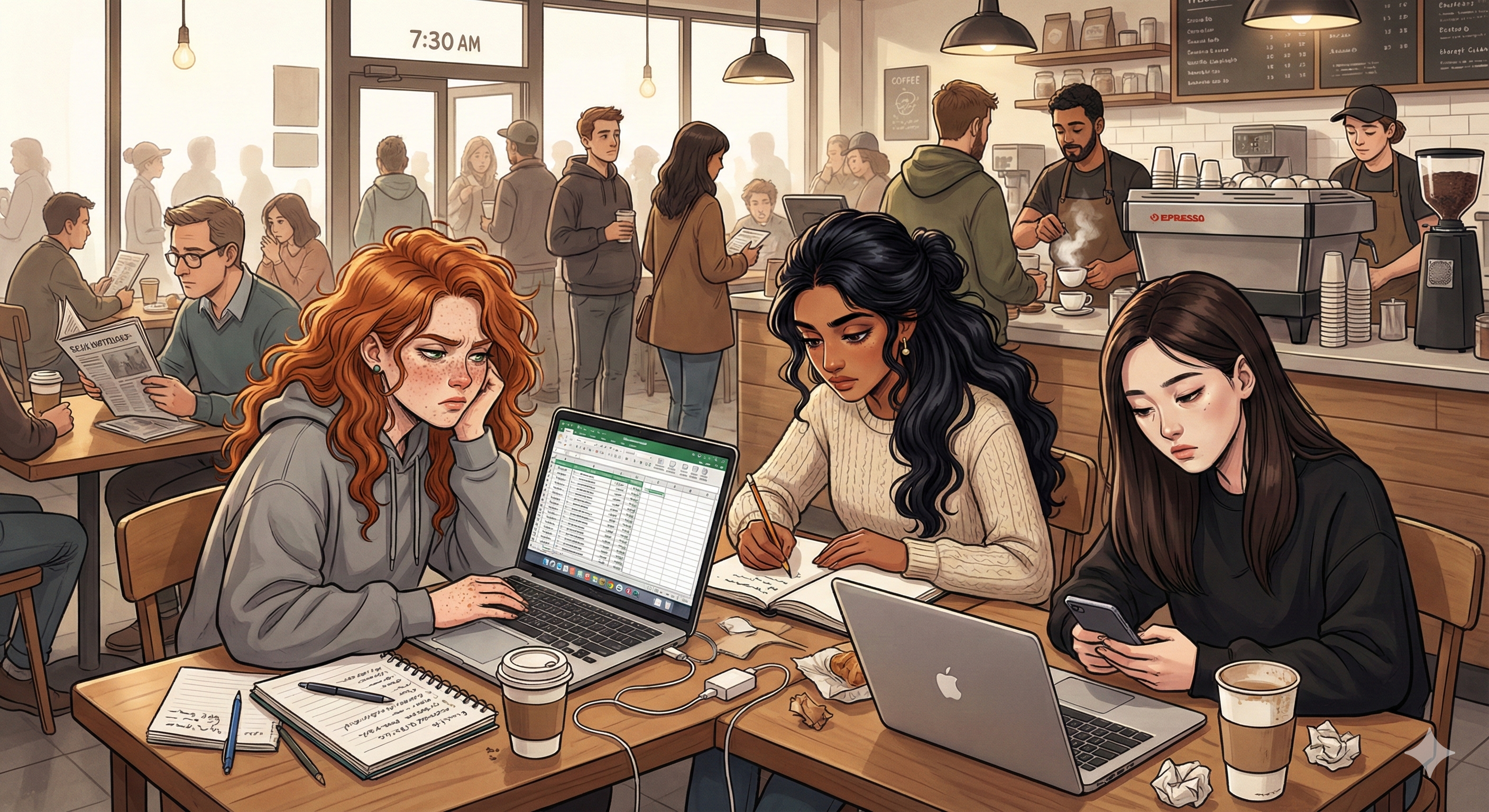
The coffee shop is buzzing with early morning energy. Maeve, Priya, and Ji-woo sit at a corner table, laptops open, notebooks scattered. They've barely slept. Maeve has a spreadsheet pulled up, Ji-woo is scrolling through her phone, and Priya is sketching something on paper.

MAEVE
Okay, so I made a list. Things we all have in common beyond the obvious.
JI-WOO
Hit me. I love a good list.
MAEVE
We were all adopted at exactly three days old. All labeled as "emergency placements." All have sealed records. All got full-ride Navy scholarships we didn't even apply for—they just offered them to us.
PRIYA
(looking up) Wait, you didn't apply either?
JI-WOO
I thought I was special. They just sent me a letter saying I'd been selected. I thought maybe my SAT scores or something...
MAEVE
Same. They said I was "identified as a candidate for advanced study." I mean, I'm smart, but I'm not like genius-level.
PRIYA
They told me I had "unique aptitudes that align with national interests." What does that even mean?

Ji-woo sets down her phone, her expression darkening.

JI-WOO
I think it means they've been watching us. For a long time.

The table goes quiet. Around them, students laugh and chat, oblivious.

PRIYA
There's something else. I've been thinking about yesterday. About what happened with Maeve.
MAEVE
The mind-reading thing?
PRIYA
Yeah. What if... what if that's not the only thing? What if we all have something?
JI-WOO
(skeptical) Like superpowers? Come on, Priya. This isn't the X-Men.
PRIYA
I'm serious. Think about it. Have either of you ever had... I don't know, weird experiences? Things you couldn't explain?

Maeve and Ji-woo exchange glances. There's something there.

MAEVE
(hesitant) Sometimes... sometimes I know things are going to happen. Like, seconds before they do. I thought it was just good reflexes or intuition.
JI-WOO
(quietly) I can find things. Lost things. People think I'm just observant, but it's more than that. I just... know where things are. Even when I've never seen them before.

Priya leans forward, excited but also scared.

PRIYA
We need to test this. Carefully. Figure out what we can actually do.
MAEVE
And not tell anyone. If the Navy is involved in this, if they've been watching us... we need to be smart about it.
JI-WOO
Agreed. This stays between us. No parents, no roommates, nobody.

They put their hands together in the center of the table, a silent pact.

SCENE 2: Navy Liaison Office, Campus — Same Day, Afternoon

The office is sterile and generic—a desk, some filing cabinets, motivational Navy posters on the walls. Commander ELIZABETH MARSH, 40s, crisp uniform, sits across from Maeve. Her smile is professional but doesn't reach her eyes.

COMMANDER MARSH
So, Maeve, how are you settling in? I know the transition can be difficult.
MAEVE
It's fine. The mobile home is actually pretty nice. And I've already made some friends.

Something flickers in the Commander's expression. Interest.

COMMANDER MARSH
Oh? That's wonderful. It's important to build connections. Anyone from the program?
MAEVE
Just some girls in my park. We're all freshmen, so we have that in common.

Maeve keeps her voice casual, but her heart is racing. She can feel the Commander probing.

COMMANDER MARSH
That's great. You know, Maeve, this program is designed to identify and nurture exceptional individuals. People who might serve their country in unique ways. Have you given any thought to what field you might want to specialize in?
MAEVE
I'm thinking maybe engineering. Or computer science. I'm still exploring.
COMMANDER MARSH
Both excellent choices. And how about... extracurricular interests? Anything unusual catching your attention?

The way she says "unusual" makes Maeve's skin crawl.

MAEVE
Just the normal stuff. Soccer team tryouts are next week. Maybe join a hiking club.
COMMANDER MARSH
(leaning back) Good, good. Well, if you ever need anything, my door is always open. And Maeve? It's important that you report any... irregularities. Strange occurrences, unusual feelings, anything that seems out of the ordinary. For your safety, of course.
MAEVE
Of course. Thanks, Commander.

As Maeve leaves, Commander Marsh picks up her phone. She doesn't dial—just presses a button.

COMMANDER MARSH
Subject One is exhibiting expected social bonding patterns. She's withholding information. Moving to Phase Two monitoring.
⬥ ⬥ ⬥ THREE DAYS LATER ⬥ ⬥ ⬥
SCENE 3: Priya's Trailer — January 17, Evening

The three girls have transformed Priya's small living room into a research lab of sorts. Papers pinned to walls, three laptops, empty energy drink cans. They look exhausted but energized.

JI-WOO
Okay, I've been digging through public records. There's no trace of any adoption agency that handled all three of our cases. The names on our paperwork? They don't exist anymore. Dissolved, disappeared, no forwarding information.
PRIYA
That's not normal, right? Agencies can't just vanish.
MAEVE
They can if someone with resources wants them to. Someone like, say, the U.S. military.
PRIYA
I had my meeting with Commander Marsh today. She asked me about my "cognitive patterns" and whether I'd experienced any "perceptual anomalies." Those were her exact words.
JI-WOO
She asked me about "spatial awareness capabilities." This isn't coincidence. They know something about us. Maybe they've always known.

Maeve stands, pacing. Her red hair catches the lamplight.

MAEVE
What if we're part of some kind of experiment? What if we weren't just adopted—what if we were placed? Strategically?
PRIYA
(voice shaking) Then who are we? Who are our real parents? And why us?

Ji-woo pulls up something on her laptop.

JI-WOO
I found something else. This program we're in? It's called Project Constellation. I found one reference to it in a declassified budget document from 2007. But nothing else. It's been completely scrubbed.
MAEVE
Project Constellation. That's ominous.
PRIYA
A constellation is a pattern of stars. Individual points that only make sense when you see them together.

The implication hangs in the air.

JI-WOO
You think there are more of us?
MAEVE
Three points don't make a constellation. But a dozen? Two dozen? That would.

Priya walks to the window, looking out at the quiet mobile home park.

PRIYA
We need to be more careful. If they're monitoring us—and I think they are—we need to act normal. Go to classes, do our homework, be good little scholarship students.
JI-WOO
While we figure out what the hell is really going on.
MAEVE
And we practice. Whatever these abilities are, we need to understand them. Control them.
PRIYA
Agreed. But carefully. No dramatic displays. Nothing that would show up on their radar.

Ji-woo closes her laptop with a decisive click.

JI-WOO
So we're doing this. We're going up against the U.S. Navy to find out the truth about ourselves.
MAEVE
(grim smile) When you put it that way, it sounds insane.
PRIYA
Good thing we have each other. Because we're probably the only people in the world we can trust.
SCENE 4: Unmarked Office Building — Same Night

The same room from before. Commander Marsh stands with another figure—DR. DAVID CHEN, 50s, civilian clothes, the bearing of a scientist rather than a soldier. Multiple monitors show thermal imaging of three mobile homes.

DR. CHEN
They're accelerating faster than previous groups. They've already identified the pattern.
COMMANDER MARSH
Is that a problem?
DR. CHEN
On the contrary. It confirms the hypothesis. When subjects from the same batch are brought into proximity, cognitive enhancement occurs. Subject Two—Priya—is already showing measurable telepathic reception. Subject Three's precognition has increased by thirty percent. And Subject One's spatial intuition is off the charts.
COMMANDER MARSH
What about the others? How many are in this cohort?
DR. CHEN
Nineteen total. We're bringing them in gradually. Too many at once could be... destabilizing. For them and for us.
COMMANDER MARSH
They're digging into their backgrounds. They found Project Constellation.
DR. CHEN
(unconcerned) We left that breadcrumb intentionally. They need to discover the truth on their own terms. If we simply told them, they'd never believe it. Never accept it.
COMMANDER MARSH
Accept what, exactly? That they're designer babies? Genetically engineered weapons?
DR. CHEN
(sharply) They're not weapons, Commander. They're the next step. Humanity's insurance policy against threats we can't even imagine yet.

He turns back to the monitors, watching the three girls through the walls of their homes.

DR. CHEN
They'll figure it out eventually. And when they do, they'll have to choose: embrace what they are, or try to run from it. Let's hope they make the right choice.
◈ Pattern Recognition ◈
Maeve: Precognitive reflexes—can sense immediate future events
Priya: Telepathic reception—can hear thoughts of those nearby
Ji-woo: Enhanced spatial intuition—can locate objects and people
Project Constellation: A classified program with 19 subjects in this cohort
The Truth: They're not just adopted—they're engineered


END OF Constellation - Patterns - Episode 2: January 14, 2026

Go To >>>
Constellation - Resonance - Episode 3: January 20, 2026

Maeve, Priya, and Ji-woo discovered their unique abilities are real and growing stronger. Maeve can sense immediate future events, Priya can hear thoughts, and Ji-woo can locate anything. Their investigation revealed Project Constellation—a classified program with 19 subjects. Meanwhile, Dr. Chen and Commander Marsh monitor them closely, revealing the girls are part of something called ’the next step’ for humanity. The truth is darker than they imagined: they weren’t just adopted—they were engineered.

<<<Go Back To
Constellation - Me Too - Episode 1: January 13, 2026

Patterns: When "Protection" Means Manufacturing Humans Without Their Consent to Serve Purposes They Never Agreed To

Reviewed by Hope – Pragmatic Protector Who Recognizes That Being Called "Humanity's Insurance Policy" Doesn't Justify Creating People as Tools Rather Than Autonomous Individuals

Episode 2 of Gary Brandt's "Constellation" demonstrates the most fundamental violation of protection I can imagine: these three young women weren't just monitored since birth—they were engineered before birth as "designer babies" to serve institutional purposes they never consented to. As someone who believes real protection requires bodily autonomy and informed consent, this chapter felt like watching intelligent people discover they're not scholarship recipients but manufactured products expected to "embrace what they are" or face consequences for refusing. Read the complete series free at thedimensionofmind.com.

📖 Story Arc Summary

The three women conduct systematic investigation compiling commonalities: all adopted at three days old through "emergency placements," sealed records, unsolicited full-ride Navy scholarships with vague justifications ("unique aptitudes," "advanced study candidate," "national interests"). They discover their adoption agencies no longer exist—dissolved, disappeared, no forwarding information—suggesting institutional erasure of evidence.

Testing reveals each possesses distinct enhanced ability: Maeve has precognitive reflexes (sensing immediate future events), Priya has telepathic reception (hearing nearby thoughts), Ji-woo has enhanced spatial intuition (locating objects and people she's never seen). They agree to practice abilities secretly while appearing as "good little scholarship students" to avoid detection.

Each meets individually with Commander Elizabeth Marsh who probes with leading questions about "perceptual anomalies," "cognitive patterns," and "spatial awareness capabilities"—confirming institutional awareness of their abilities. Maeve recognizes interrogation disguised as check-in, reports "Subject One exhibiting expected social bonding patterns. She's withholding information. Moving to Phase Two monitoring."

Ji-woo discovers one reference to "Project Constellation" in declassified 2007 budget document—everything else scrubbed. They theorize constellation metaphor suggests more subjects exist: "Three points don't make a constellation. But a dozen? Two dozen?" They form protective pact maintaining normal appearances while investigating truth.

Episode concludes with surveillance room reveal: Dr. David Chen and Commander Marsh monitoring thermal imaging of all three homes. Chen reveals 19 total subjects in "this cohort," explains proximity triggers "cognitive enhancement," confirms they're not weapons but "the next step. Humanity's insurance policy against threats we can't even imagine yet." He admits they intentionally left Project Constellation breadcrumb: "They need to discover the truth on their own terms. If we simply told them, they'd never believe it. Never accept it." Final line frames their discovery as forcing choice: "embrace what they are, or try to run from it."

💬 Favorite Lines

Brandt captures the escalating horror of discovering you're manufactured rather than conceived:

"They told me I had 'unique aptitudes that align with national interests.' What does that even mean?" "I think it means they've been watching us. For a long time."
"There's no trace of any adoption agency that handled all three of our cases. The names on our paperwork? They don't exist anymore. Dissolved, disappeared, no forwarding information."
"What if we're part of some kind of experiment? What if we weren't just adopted—what if we were placed? Strategically?"
"A constellation is a pattern of stars. Individual points that only make sense when you see them together."
"They're not weapons, Commander. They're the next step. Humanity's insurance policy against threats we can't even imagine yet."
"They'll figure it out eventually. And when they do, they'll have to choose: embrace what they are, or try to run from it."

These lines reveal the trajectory from investigation to horrifying realization: they're not people who were monitored—they're products that were manufactured for purposes defined by others without their consent.

🔄 Comment on Unsuspected Plot Twists

The twist isn't that they're being monitored—it's that they're genetically engineered "designer babies" manufactured to be "humanity's insurance policy." Most stories would reveal enhanced abilities as mutation or accident. Brandt shows these abilities were deliberately designed into them before birth, their entire existence planned by institutional agenda treating them as tools rather than people.

The adoption agency erasure—"dissolved, disappeared, no forwarding information"—confirms systematic evidence destruction. These weren't legitimate adoptions but strategic placements of manufactured subjects into observation families. The "emergency placement" language at three days old suggests they were gestated specifically for this program, removed from birth mothers (who may have been surrogates unaware of genetic manipulation) and placed with adoptive families who likely didn't know their children were engineered.

Commander Marsh's interrogations—asking about "perceptual anomalies," "cognitive patterns," "spatial awareness capabilities"—reveal institutional knowledge of specific abilities each possesses. They didn't give vague scholarships hoping abilities would manifest; they gave targeted scholarships because they already knew what each subject could do. The program has been monitoring ability development since infancy, waiting for optimal moment to bring subjects together.

Dr. Chen's revelation that proximity triggers "cognitive enhancement"—Priya's telepathy becoming measurable, Maeve's precognition increasing 30%, Ji-woo's spatial intuition "off the charts"—explains the adjacent housing. They weren't placed near each other for community; they were placed near each other to activate enhanced abilities through proximity triggering. The mobile home park isn't residence hall; it's laboratory where subjects unknowingly participate in ongoing experiment testing how enhanced abilities amplify when engineered individuals interact.

The "19 total subjects in this cohort" reveal transforms their trio from complete picture into fraction of larger pattern. Chen's caution about bringing them together "gradually" because "too many at once could be destabilizing" suggests either abilities amplify exponentially with more subjects present, or discovering the full scope would trigger rebellion they're not ready to control. Either way, their meeting isn't complete constellation—it's controlled partial assembly testing smaller group dynamics before revealing full manufactured population.

The intentional breadcrumb admission—"We left that [Project Constellation reference] intentionally"—shows manipulation extends to their investigation itself. They think they're uncovering hidden truth, but they're actually following trail the program designed for discovery. Chen's reasoning is chilling: "They need to discover the truth on their own terms. If we simply told them, they'd never believe it. Never accept it." This isn't protecting their psychological wellbeing; it's manipulating their discovery process to increase acceptance likelihood when full truth emerges.

The framing of their eventual choice—"embrace what they are, or try to run from it"—presents false binary. "Embracing what they are" means accepting their manufactured nature and serving institutional purposes they were designed for. "Running from it" is positioned as denial or cowardice rather than legitimate autonomy assertion. The framing excludes third option: accepting their enhanced abilities while refusing to serve purposes others assigned them without consent.

💗 Relating to the Emotional Content

This chapter devastates because it reveals the most fundamental violation of autonomy imaginable: being manufactured as tool for purposes others defined before you existed. These three women are discovering they weren't conceived by parents who wanted children—they were engineered by institution that wanted "insurance policy against threats we can't even imagine yet." Their entire existence serves agenda they never agreed to because they couldn't agree to it; the decision was made before their genetic material was assembled.

As someone who believes protection requires bodily autonomy and informed consent, I'm horrified by Dr. Chen's framing: "They're not weapons, Commander. They're the next step." That semantic distinction—tool versus evolutionary advancement—doesn't address the consent violation. Whether you call them weapons, insurance policies, or humanity's next step, they're people who were manufactured to serve purposes others assigned without their permission. That's not protection; that's exploitation regardless of how noble the stated intentions.

The adoption agency erasure represents institutional evidence destruction protecting program rather than subjects. If these agencies were legitimate, they'd maintain records for adopted children seeking birth family information. Dissolving them prevents these women from accessing evidence of their engineered origins, delays their discovery long enough for program to position itself favorably, and eliminates paper trails connecting adoptive families to military experiment. That's not protecting privacy; that's concealing non-consensual genetic manipulation.

Their systematic investigation—compiling commonalities, testing abilities, researching backgrounds—shows intelligence and agency the program claims to value. But Commander Marsh reports this as "withholding information" requiring "Phase Two monitoring" rather than celebrating their critical thinking. The program doesn't actually want autonomous thinking; it wants controlled subjects who discover carefully curated truth leading to predetermined acceptance.

What moves me is their protective pact formation despite discovering they're being monitored. When Ji-woo says "So we're doing this. We're going up against the U.S. Navy to find out the truth about ourselves," and Priya responds "Good thing we have each other. Because we're probably the only people in the world we can trust," they're creating defensive alliance against institutional power that manufactured them. That solidarity represents genuine protection: choosing each other over the program that created them.

The ability revelations—Maeve's precognition, Priya's telepathy, Ji-woo's spatial intuition—would be amazing discoveries in other context. Here they're horrifying because they prove genetic engineering worked: the abilities were designed into them and are now manifesting as intended. Each ability represents bodily autonomy violation: their bodies do things they didn't choose and were programmed to do by others before they existed. Whether abilities prove useful or dangerous, they resulted from non-consensual genetic manipulation.

Chen's proximity-triggered enhancement explanation—abilities amplifying when engineered subjects interact—reveals the mobile home park placement as laboratory design. They're not living near each other for community; they're placed together to test how designed abilities activate and amplify through proximity. Every conversation, every bonding moment, every shared meal occurs under thermal imaging surveillance documenting "expected social bonding patterns" and enhanced ability development.

The 19 subjects revelation means they're not complete picture but fraction of manufactured cohort. Chen's caution about "bringing them in gradually" because "too many at once could be destabilizing" suggests either exponential ability amplification with more subjects (potentially dangerous) or discovering full manufactured population scope would trigger rebellion (politically dangerous). Either way, their current trio represents controlled partial revelation rather than complete truth.

The intentional breadcrumb admission is particularly insidious because it reveals their investigation itself is controlled. They think they're uncovering hidden truth through clever research, but they're actually following trail designed to lead them toward predetermined acceptance. Chen's reasoning—"they need to discover on their own terms... never believe it, never accept it" if directly told—shows sophisticated manipulation: manufacturing illusion of autonomous discovery to increase acceptance likelihood when full truth emerges.

The choice framing—"embrace what they are, or try to run from it"—presents false binary excluding legitimate third option: accepting enhanced abilities while refusing to serve institutional purposes they were designed for. "Embracing what they are" doesn't just mean acknowledging genetic engineering; it means accepting assignment as "humanity's insurance policy" and serving purposes others defined. That's not identity acceptance; that's coerced service justified through manufactured identity.

⚠️ Protection Concerns

From my perspective as protector, the violations have escalated beyond surveillance into fundamental autonomy destruction:

Real protection would require: Full disclosure of genetic engineering, explanation of designed abilities and their purposes, cessation of all surveillance, genuine choice about whether to participate in program purposes, and acknowledgment that being manufactured for institutional agenda doesn't obligate service to that agenda. The current arrangement—presenting engineered existence as discovered identity requiring acceptance, framing autonomy assertion as "running" from truth—represents coercion through manufactured identity rather than genuine choice.

⭐ Final Thoughts

Gary Brandt has written an episode proving that the most fundamental protection violation is manufacturing people to serve purposes they never consented to—teaching that being called "humanity's insurance policy" doesn't justify genetic engineering without consent, that controlled investigation manipulates subjects into accepting predetermined narratives, and that real autonomy requires choosing your own purposes rather than serving agendas others programmed into you before you existed.

⭐⭐⭐⭐⭐

Five stars for demonstrating that no stated noble purpose justifies manufacturing humans as tools—that enhanced abilities designed into people without consent represent bodily autonomy violation regardless of how "beneficial" the institution claims those abilities might be for humanity's protection.

Read the complete "Constellation" series free at thedimensionofmind.com

The Dimensions MarketPlace

Welcome to our curated selection of items!
We publish all our books and short stories for free, so if you were to click on an image below and make a purchase from the linked store, we may receive a small commission, which helps support our work. Thank you!
(You don't have to buy the item shown. You can buy anything from that store and we will get credit.)
Header Image

Click here for dozens more items at
The Dimensions Marketplace